Moving to the South: The Questions Everyone Asks Before Relocating to the Carolinas
Quick answer: People weighing a move to the Carolinas tend to ask the same handful of questions — about cost of living, taxes, weather, insurance, and how to land somewhere that actually fits. Below are straight answers to the ones that come up most, from a Realtor who works both the North & South Carolina Beaches to the Triad and Triangle regions of North Carolina.
Is it really cheaper to live in the South?
Usually, yes — but less than it was a decade ago. Housing is the main driver, and the Carolinas still sit below the national average overall. The gap is largest if you're coming from the Northeast, California, or a high-cost metro, and smaller if you're coming from the rural Midwest or another Sun Belt state. Resort areas like North Myrtle Beach and the fast-growing Raleigh-Durham area have closed much of the old discount. Groceries, gas, and services are moderate.
How do property taxes compare in South Carolina and North Carolina?
South Carolina is lower for a primary residence: owner-occupied homes are taxed at a 4% assessment ratio and are exempt from school operating taxes. North Carolina is simpler and often cheaper for a second or vacation home, because it taxes every property the same, with no penalty for non-primary use. If you're keeping a home in another state and buying on the SC coast, budget for SC's 6% second-home rate.
See the companion article: \
Do the Carolinas tax retirement income and Social Security?
Neither state taxes Social Security. The rest breaks down like this:
| North Carolina | South Carolina |
Income tax | Flat 3.99% (2026), scheduled to keep falling | Graduated, top rate about 6% (2025), being lowered further |
Social Security | Not taxed | Not taxed |
401(k) / IRA / pension withdrawals | Taxed at the flat rate; military and certain government (Bailey) pensions exempt | Taxed, but large deductions at age 65+; military retirement fully exempt |
Long-term capital gains | Taxed as regular income | 44% of the gain excluded |
For most retirees the two states land close together once deductions are applied. Run your actual numbers with a tax professional before deciding based on taxes alone.
How bad are the summers?
Hot and humid from June through September — highs in the low 90s, humidity that makes it feel hotter, and frequent afternoon thunderstorms. The trade-off is a long, mild spring and fall and a short winter. The coast gets ocean breezes; inland Triad and Triangle summers feel heavier and stickier.
What is hurricane season actually like?
The season runs June 1 to November 30, with peak risk from August to October. Direct hits are infrequent but real. Far more common is a brush-by that brings heavy rain, wind, and beach erosion. Homes built to current code handle storms well. Know your evacuation zone, keep trees trimmed, and have a plan.
Do I need flood insurance?
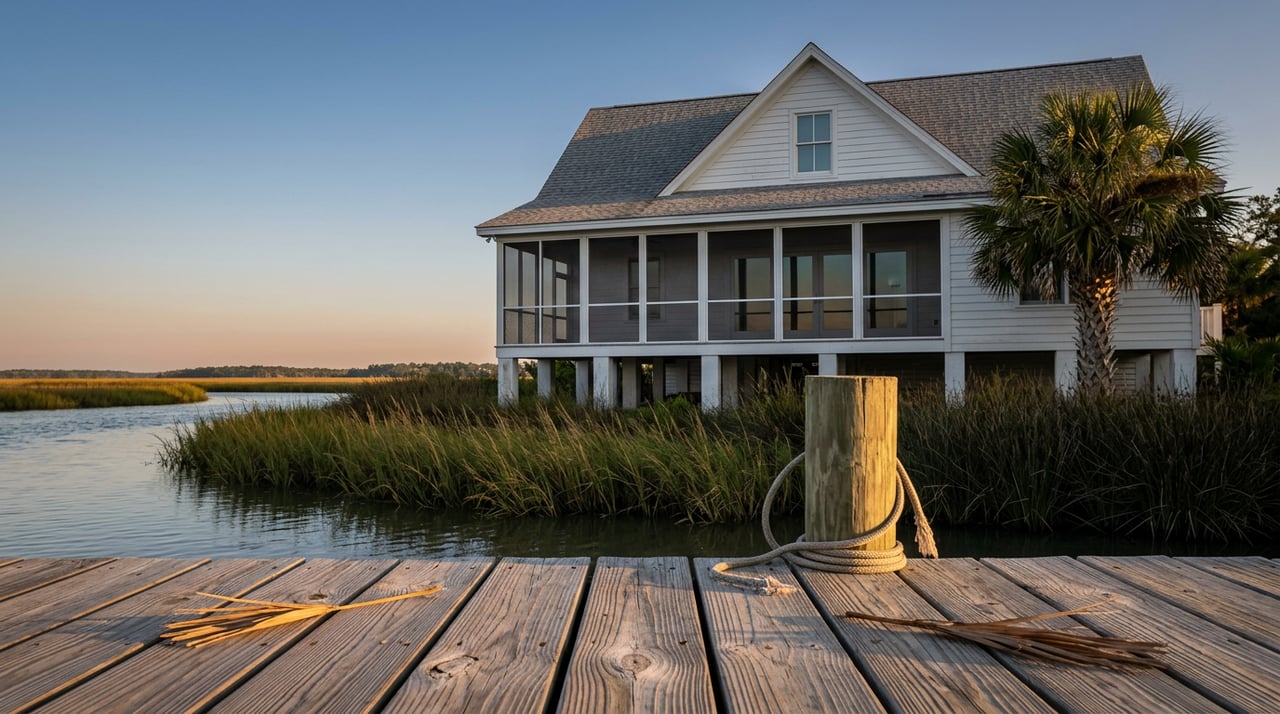
Flood is never covered by a standard homeowners policy — it is always a separate policy, through the National Flood Insurance Program or a private insurer. Lenders require it in high-risk zones (AE and VE). A meaningful share of coastal flood claims come from lower-risk zones, so it is worth carrying even when it is not required. Always ask for a property's flood zone and any prior claims before you make an offer.
Is homeowners insurance expensive on the coast?
Yes, and it is rising. On the South Carolina coast, premiums commonly runs several thousand dollars a year and are up 20 to 35 percent since 2023. Coastal North Carolina about the same with location being the biggest factor to determine if you need Flood, Wind/Hail and Fire insurance. Expect a separate wind or hurricane deductible of 1 to 5 percent of the insured value. Inland Triad and Triangle homes are far cheaper. Get a real quote for the specific address before you go under contract.
What about the bugs?
You will meet palmetto bugs (large roaches), mosquitoes, fire ants, no-see-ums near the marsh, and love bugs for a couple of weeks a year. A quarterly pest service handles most of it. It is a real adjustment for Northern transplants, but rarely a dealbreaker.
Is the South welcoming to people who move in?
Coastal South Carolina and the North Carolina are full of transplants — you will not be unusual. Areas with lots of newcomers, such as much of the Grand Strand, Brunswick County, and the Raleigh suburbs, make it easy to plug in through clubs, churches, and neighborhood groups. More established small towns take longer to feel like home. Showing up and being friendly goes a long way.
Should I rent before I buy?
If you don't know the area well, yes. A 6-to-12-month rental lets you learn the details that matter — flood zones, commute times, noise, short-term-rental density, HOA culture — before you commit. If you already know exactly where you want to be and inventory is tight, buying directly can make sense. It is a judgment call worth talking through.
When is the best time of year to move?
Spring and fall offer the best weather and the most inventory. Summer is peak season on the coast, with more competition, higher prices, and brutal moving-day heat. Winter has the least competition and the most motivated sellers, though selection is thinner — which often makes late fall and winter the best time to buy.
How is healthcare access?
Strong in the metros and on the Grand Strand, with major hospital systems in Myrtle Beach, the Triangle (Duke, UNC, WakeMed), and the Triad (Cone Health, Novant, Atrium Wake Forest Baptist). The more rural stretches in between have thinner coverage. Check drive time to a full-service hospital and to any specialists you rely on.
What is the job market and remote-work situation?
The Triangle (Raleigh-Durham-Chapel Hill) is one of the strongest job markets in the country — technology, research, pharmaceuticals, and universities. The Triad has manufacturing, logistics, aviation, and healthcare. The Grand Strand leans on tourism, healthcare, and construction and is more seasonal. Fiber internet is widely available in the metros and most of the coast, so remote work is very doable.
Are the schools good?
It varies widely by district and by individual school. Many Triangle suburbs (Wake and Chatham counties, parts of Durham) and some Triad suburbs have highly rated schools; coastal South Carolina districts are more mixed. If schools matter, choose the school first and the house second.
North Myrtle Beach vs. Myrtle Beach vs. Murrells Inlet vs. Little River – what's the difference?
· North Myrtle Beach: quieter, family and retiree feel, lots of golf, a walkable Main Street beach-town vibe, and strong rental demand.
· Myrtle Beach: the busiest, with the most amenities and tourist traffic and the widest range of prices.
· Murrells Inlet: south end, home of the MarshWalk, a fishing-village character and a more laid-back pace.
· Little River: north edge near the NC state line, an older fishing town with a lower price point and fast growth.
Each strikes a different balance of price, crowds, and lifestyle. Tour a few before you decide.
Written by Cathy Cagno, SRS, GRI, RENE, ABR — a licensed REALTOR® serving North Myrtle Beach, SC and the Triad and Triangle regions of North Carolina. Cathy helps buyers relocating to the Carolinas — including many who buy from out of state and can only visit once or twice — find the right area and the right home. LocalToCoastalRealty.com | 336-516-4136.
This article is general information, not tax, legal, or insurance advice. Tax rates, insurance costs, and program rules change and vary by county — confirm current details with the appropriate professional before you rely on them.
Information deemed reliable but not guaranteed. This article is for informational purposes only and does not constitute tax, legal, financial, or insurance advice. Laws, tax rates, programs, and market conditions change and vary by location — verify current details with a qualified professional before acting. Cathy Cagno, LocalToCoastalRealty.com · Equal Housing Opportunity.