In February 2026, Fisher Park's median sale price was reported up 20.1% year over year, landing around $442,000 and briefly making it Greensboro's most competitive historic address. Five months later, the same neighborhood's year-over-year comparison flipped hard: a reported drop of 32.3%, with the median falling to $459,900 from $679,375 the July before.
Read those two numbers again. Fisher Park did not get 20% hotter and then a third cheaper in the space of five months. The neighborhood didn't change. The sample size did.
Why five sales can swing a median by six figures
Fisher Park is a small, sought-after historic district a short walk from the Greenway, Revolution Mill, and a strip of restaurants that includes Joymongers, Deep Roots, The Ballpark, Sage Mule, and Fisher's. It's also a neighborhood where homes rarely trade in bulk. Only five homes were listed for sale there in July 2026, up from just two the year before. By August, the median list price on those active listings sat at $629,000, nearly $170,000 above the $459,900 median that homes had actually sold for the month prior. In a deeper market, that gap closes through hundreds of negotiations until list and sold prices converge into a meaningful number. In a market this thin, the gap just means the handful of homes listed and the handful of homes sold weren't the same handful of homes, and a year-over-year comparison built on an equally small sample tells you almost nothing about where prices are actually heading.
This is the piece that gets lost when a headline stat travels from a listing site to a group chat to a buyer's assumptions: a year-over-year percentage is only as trustworthy as the count behind it. Ten sales compared to eight sales is a real signal. Five sales compared to two is closer to a coin flip.
The same pattern showed up in Old Irving Park
Fisher Park isn't the only historic Greensboro address where this plays out. In March 2026, Old Irving Park recorded a median sale price of $378,000, reported as a 14.9% decline year over year, on just 14 closed sales compared to 22 the year prior. Homes there averaged 60 days on market that month, more than double the 29 days recorded a year earlier.
None of that means Old Irving Park cooled by 15%. It means Old Irving Park's housing stock spans an enormous range, from $200,000 bungalows on the neighborhood's south and west edges to estates ringing the private Greensboro Country Club priced between $900,000 and $2 million. The neighborhood's most expensive recent sale, a mansion built for textile heir Benjamin Cone, closed at $4.5 million in early 2024. Trailing 12-month figures for the neighborhood run higher than that single March snapshot, generally landing between $450,000 and $490,000 depending on the month measured, a blended number that depends entirely on which slice of that price range happened to close. Fourteen sales isn't enough to smooth that out. It's enough to make the median swing wherever the biggest sale of the month happens to land.
What a real trend looks like: Lindley Park
For contrast, look at Lindley Park, five miles west of downtown along Spring Garden Street. Over the three months ending May 2026, Lindley Park's median sale price was $309,000, up 11.9% year over year, on 12 closed sales, up from 8 the year before. Homes there averaged 24 days on market, essentially unchanged from the 25 days recorded a year earlier.
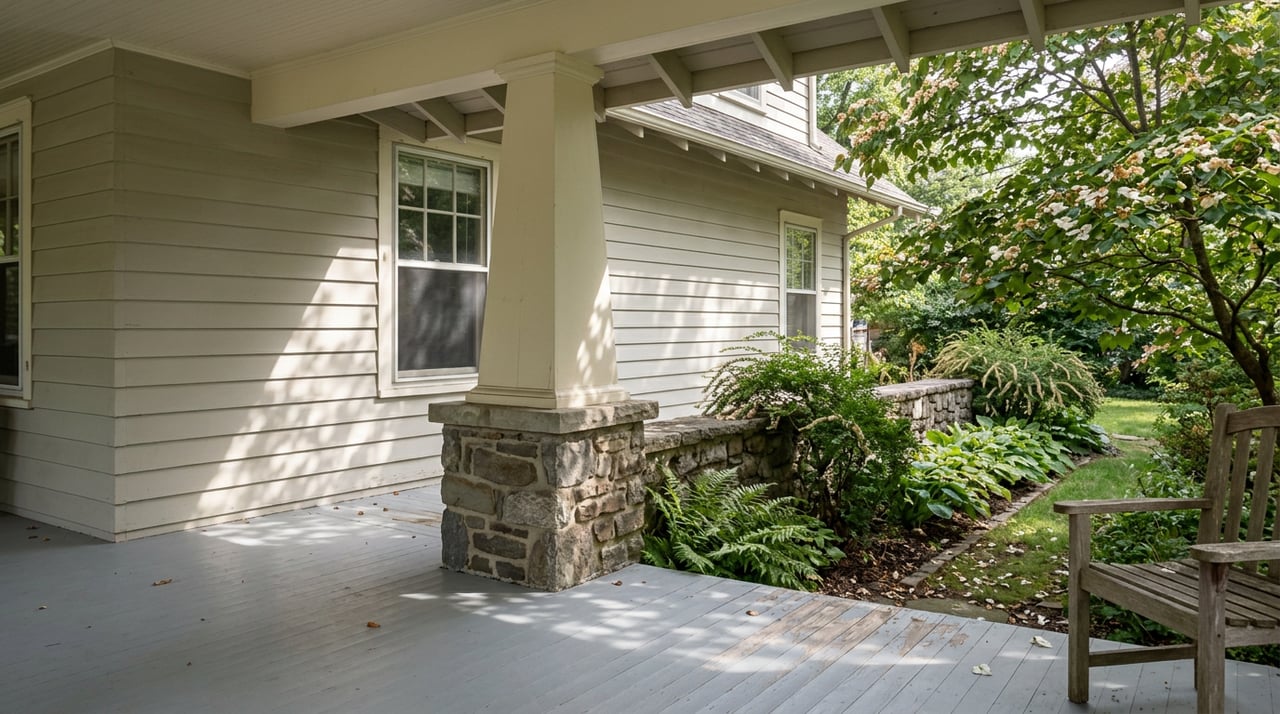
That's what a trustworthy trend looks like: sales volume moving up rather than down, and a days-on-market figure that barely budges. Lindley Park was built around the 100-acre park that Greensboro nurseryman John Van Lindley donated to the city in 1917, and the neighborhood still runs on the small, walkable rhythm that donation created. The adjacent 17-acre Greensboro Arboretum sits within an easy walk of most homes, and residents move along Spring Garden Street and Walker Avenue to spots like Common Grounds, Spring Garden Bakery & Coffee, and The Corner rather than driving to reach dinner. Housing stock predates 1970 almost entirely, bungalows and Cape Cods with the kind of wraparound porches that newer construction skips, and the neighborhood is zoned for Grimsley High School.
Put those two facts side by side. Lindley Park delivers walkable, pre-1970 character within a few miles of Fisher Park's blocks, at roughly two-thirds the price and with a sales pattern that actually behaves like a market instead of a coin flip.
What the Country Club premium buys instead
None of this is an argument against Fisher Park or Old Irving Park. It's an argument for knowing what you're paying for and why the number in front of you moves the way it does.
Old Irving Park's upper range exists because of proximity to the Greensboro Country Club, a private club with two golf courses, tennis courts, and a pool sitting at the physical center of the neighborhood. Homes near the course face the fairways directly, a layout unique enough locally that residents can watch play from their own front lawn. That view, plus Federal, Georgian, and Italianate architecture dating to the neighborhood's early-1900s development, is what the $900,000 to $2 million tier is actually buying. Nearby New Irving Park trades at a step down from that, with a December 2025 median list price near $564,000.
Sunset Hills, meanwhile, sits in its own category. Listed on the National Register of Historic Places since January 2013, the 280-acre district contains 912 contributing buildings built between 1925 and 1965, in Colonial Revival, Tudor Revival, and Craftsman styles, designed in part by architects Lorenzo S. Winslow and Albert C. Woodroof. It runs between West Friendly Avenue, Elam Avenue, West Wright Avenue, South Tremont Drive, North Aycock Street, and Kensington Road, close enough to walk to both Friendly Center and UNCG. Homes there reportedly sell in around 25 days in 2026, well below the broader Greensboro median of 38 days cited for the same period, and well-priced listings have drawn multiple offers within the first weekend. That's a neighborhood where demand is steady enough that the numbers hold together month to month, closer to Lindley Park's pattern than to Fisher Park's.
Reading these numbers before you fall in love with a block
None of this means ignore the headline stat. It means ask a second question before you act on it.
- How many homes actually sold, not just listed, in the period being compared
- Whether the comparison period a year ago had a similarly small count
- Whether list price and sale price are being compared to each other or to different months entirely
- Whether days on market moved in the same direction as the price, which tends to confirm a real shift, or in the opposite direction, which tends to flag noise
Greensboro's broader market gives you a baseline to check any of these against. Citywide, the median sale price ran $289,000 in December 2025, up 5.5% year over year, on 250 closed sales that month compared to 241 the year before, a large enough pool that the percentage means roughly what it says. When a historic pocket like Fisher Park or Old Irving Park reports a swing two or three times larger than that citywide number on a fraction of the sales, the swing is telling you about sample size before it tells you about demand.
Part of what a relocation into any of the Triad's historic pockets requires is exactly this kind of read, not just a citywide average but the sales count and days-on-market pattern behind each neighborhood's specific number. That's true whether you're comparing Fisher Park to Lindley Park or weighing an inland Piedmont neighborhood against a coastal second home three hours east.
Frequently asked questions
Why did Fisher Park's median price appear to drop by nearly a third in one year? Because the comparison rests on a small monthly sales count. In a month with only a handful of closings, one larger estate sale or one smaller bungalow closing can swing the median significantly without reflecting any real change in what buyers are willing to pay for a typical home there.
Is Lindley Park a more predictable purchase than Fisher Park or Old Irving Park? Its recent pricing has moved in a narrower, more explainable range, supported by a growing rather than shrinking sales count and a days-on-market figure that barely changed year over year. That doesn't make Fisher Park or Old Irving Park bad choices. It means their headline percentages need a sales-count check before you weigh them against each other.
What actually separates Old Irving Park from New Irving Park in price? Mostly proximity to the Greensboro Country Club. Old Irving Park's estates ringing the golf course, some dating to the early 1900s, sit at the top of the range, while New Irving Park's December 2025 median list price of $564,000 ran well below that country-club tier.
If you're weighing Greensboro's historic core against a move, a downsize, or a second home somewhere along the Grand Strand, the number on a listing page is the beginning of the conversation, not the end of it. Local to Coastal Realty works both sides of that conversation, inland Triad and coastal Carolina alike, and can walk through what a specific neighborhood's numbers actually mean before you make an offer. Request a free consultation to start that conversation.