Golf Cart vs. Low-Speed Vehicle (LSV): What Grand Strand Buyers Should Know Before They Buy One
Quick answer: A golf cart and a low-speed vehicle (LSV) look almost the same but are legally different. A permitted golf cart tops out around 20 to 25 mph, gets a $5 SC DMV decal, and in North Myrtle Beach can only be driven in daylight. An LSV is built to federal safety standards, has a VIN, is titled and plated like a car, can be driven at night, and is subject to annual county property tax. If you want to drive after sunset or use it as a real errand vehicle, buy an LSV. If you only need short daytime trips close to home, a permitted golf cart is cheaper and simpler.
The legal definitions
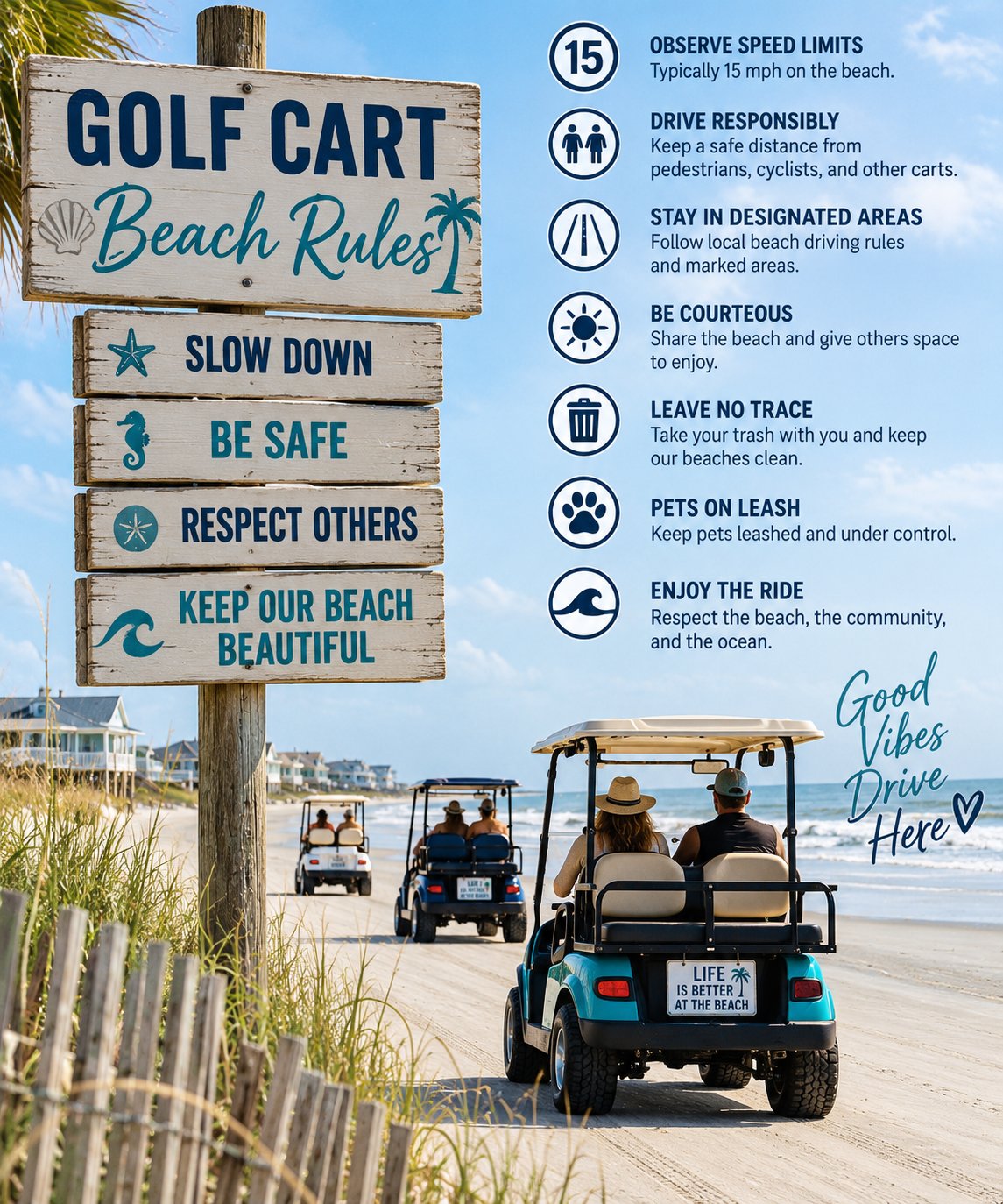
· Golf cart: a vehicle designed for use on a golf course, generally limited to about 20 to 25 mph. South Carolina lets a ''permitted golf cart'' operate on certain public roads with a DMV permit decal.
· Low-speed vehicle (LSV): a four-wheeled vehicle with a top speed of more than 20 but not more than 25 mph, manufactured to meet Federal Motor Vehicle Safety Standard 500 — seat belts, headlights, brake lights, turn signals, a windshield, mirrors, and a 17-character VIN. It is legally a motor vehicle. An electric LSV is often called a neighborhood electric vehicle, or NEV.
Side by side
| Permitted golf cart | Low-speed vehicle (LSV) |
Top speed | About 15-25 mph | More than 20, up to 25 mph |
Safety equipment | Not required by law | Federally required: belts, lights, signals, windshield, mirrors, VIN |
SC registration | $5 permit decal (Form GC-2), valid 5 years | Full DMV title + registration + license plate (Form 400) |
Driver's license | Required (16+) | Required |
Insurance | Golf cart liability policy required | Auto-style liability required (25/50/25 minimums) |
Annual property tax | No | Yes, billed by the county |
Night driving in North Myrtle Beach | No — sunrise to sunset only | Yes |
Where it can go | Secondary roads 35 mph or less, within 4 miles of your address | Roads posted 35 mph or less; may cross faster roads |
Typical cost | Used carts from a few thousand dollars | New LSVs often $12,000-$20,000+ |
Which should you buy?
· Buy a permitted golf cart if: you mostly drive within your own community, your trips are short and in daylight, you are on a tight budget, or you already own a cart.
· Buy an LSV if: you want to drive at night (dinner out, evening events), you want real seat belts and lighting, you want a titled vehicle, or you plan to use it as a genuine second car for errands.
Watch out: the ''golf cart'' you are buying might be an LSV, or vice versa
· Many dealers sell street-ready vehicles that are actually LSVs. They come with a VIN and a manufacturer's statement of origin (MSO) or title, and must be registered like a car.
· A used golf cart with added lights and mirrors is still a golf cart. Retrofitting equipment does not make it an LSV. LSV status depends on how the vehicle was built and certified by the manufacturer.
· Before you buy, look for a VIN plate, ask for the title or MSO, and confirm in writing how the seller says it must be registered.
Registering each in South Carolina
· Golf cart: complete SCDMV Form GC-2, show your driver's license and proof of golf cart liability insurance, provide proof of ownership, and pay $5. The decal lasts five years or until you move.
· LSV: title and register it like a car. Submit Form 400 with the MSO or title and a bill of sale, pay the $15 title fee, pay property tax to your county first, provide proof of auto liability insurance, and pay the registration fee (about $24 for two years) plus the Infrastructure Maintenance Fee or applicable sales tax. You then receive a standard SC license plate and a property tax bill every year after.
How this fits into buying a home on the Grand Strand
· If nighttime cart use matters to you, you need an LSV — build the higher purchase price and the annual property tax into your budget.
· Either way, confirm your neighborhood's road speeds and HOA rules work for the vehicle you choose. See the companion article on North Myrtle Beach golf cart rules.
· If a cart conveys with a home you are buying, find out whether it is a golf cart or an LSV before closing — it changes what you must do to put it on the road.
Frequently asked questions
What is the difference between a golf cart and an LSV?
A golf cart is a low-power vehicle that gets a $5 DMV permit decal. An LSV is a federally regulated motor vehicle with a VIN, a title, and a license plate. Only the LSV can be driven at night in North Myrtle Beach.
Can I drive an LSV at night in North Myrtle Beach?
Yes. LSVs may be driven after dark. Golf carts may not, regardless of their lighting.
Do I pay property tax on a golf cart in South Carolina?
Not on a permitted golf cart. You do pay annual county property tax on an LSV, because it is registered as a motor vehicle.
Can I convert my golf cart into an LSV?
No. Adding lights, mirrors, and seat belts does not make it an LSV. LSV status is set by the manufacturer at the time it is built and certified.
How fast does an LSV go?
By definition, more than 20 miles per hour but not more than 25.
Is an LSV the same as a NEV?
Yes. A neighborhood electric vehicle (NEV) is simply an electric low-speed vehicle.
Written by Cathy Cagno, SRS, GRI, RENE, ABR — the Broker-in-Charge of Local to Coastal Realty, serving North Myrtle Beach, SC and the Triad and Triangle regions of North Carolina. Cathy helps buyers weigh the golf-cart-versus-LSV question against how they actually plan to get around. LocalToCoastalRealty.com | 336-516-4136.
Vehicle classifications, fees, and registration rules are set by the SC DMV and change over time. Confirm current requirements at dmv.sc.gov and with your county before you buy or register a golf cart or LSV.
Information deemed reliable but not guaranteed. This article is for informational purposes only and does not constitute tax, legal, financial, or insurance advice. Laws, tax rates, programs, and market conditions change and vary by location — verify current details with a qualified professional before acting. Cathy Cagno, LocalToCoastalRealty.com · Equal Housing Opportunity.