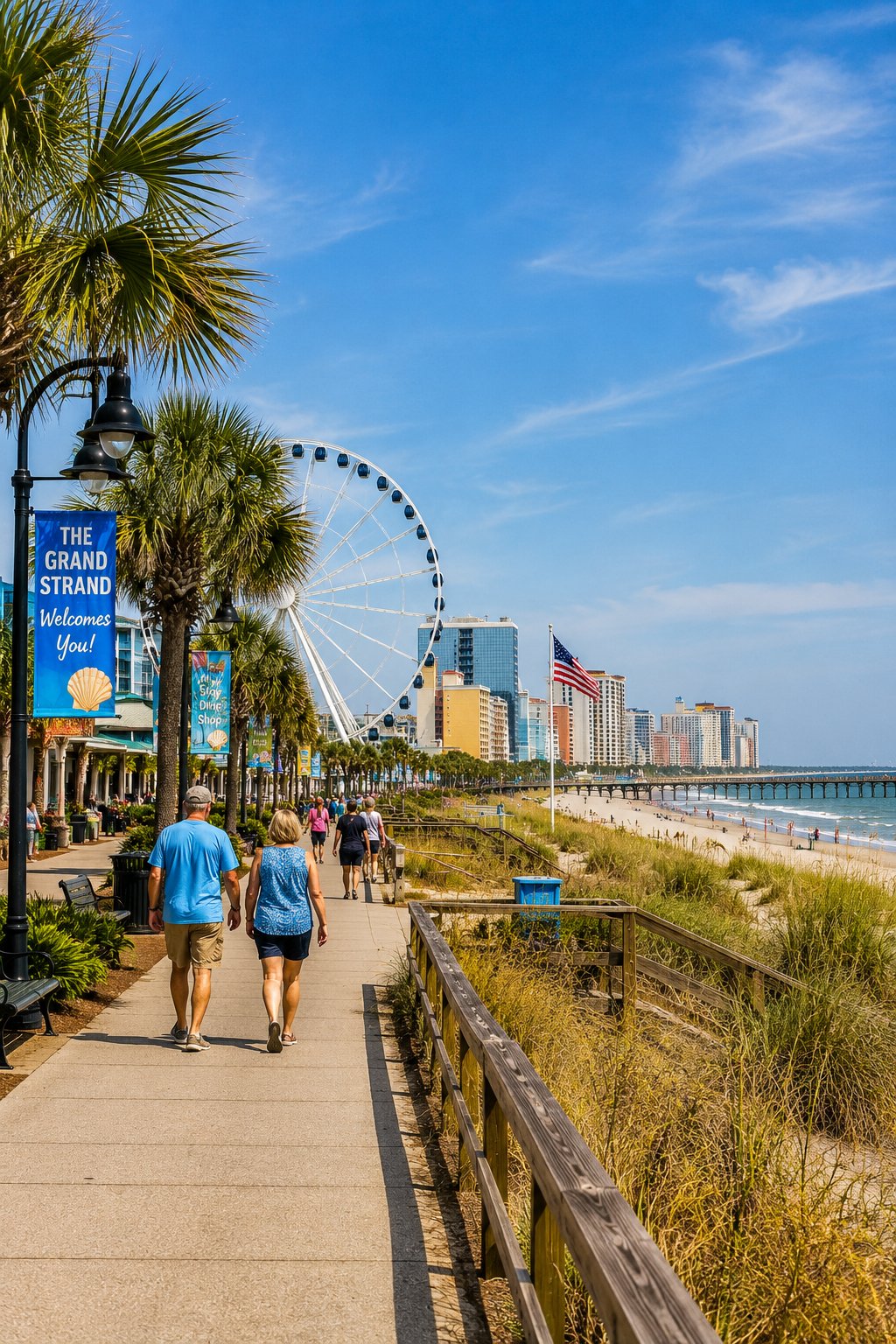
Living on the Grand Strand Year-Round: What It's Really Like
Quick answer: Year-round life on the Grand Strand means glorious spring and fall, a hot and humid summer shared with millions of tourists, and a quiet, mild off-season from roughly November through February when traffic thins and some seasonal businesses cut back their hours. Winters are short and mild, with highs often in the upper 50s to low 60s. The people who love it full-time value the beach access, the low cost of living, the golf, and the large community of fellow transplants; the ones who struggle miss four real seasons, a big-city arts and dining scene, or family back home.
What ''the Grand Strand'' actually means
It is a roughly 60-mile stretch of the South Carolina coast from Little River near the North Carolina line down to Georgetown. From north to south the main communities are Little River, North Myrtle Beach, Myrtle Beach, Surfside Beach, Garden City, Murrells Inlet, and Pawleys Island, plus inland areas like Carolina Forest, Conway, and Longs. Each has its own feel, from the family-and-golf calm of North Myrtle Beach to the fishing-village character of Murrells Inlet.
The off-season reality
From about November through February the Strand is a different place:
· Traffic drops sharply. A drive that takes 40 minutes in July takes 15 in January.
· Some businesses reduce hours or close. A number of beachfront restaurants, mini-golf courses, and attractions run limited winter schedules or shut down until spring. The bigger year-round establishments stay open.
· Snowbirds arrive. January through March brings a wave of winter residents from the Northeast and Canada, which fills condos, golf courses, and restaurants back up midweek.
· The beach is yours. Long, quiet winter beach walks are one of the real perks of living here.
Weather through the year
· Spring (Mar-May): the best season warm days, low humidity, blooming everything.
· Summer (Jun-Sep): highs in the low 90s, high humidity, afternoon thunderstorms, warm ocean, peak crowds.
· Fall (Oct-Nov): a second best season warm water, thinning crowds, mild air.
· Winter (Dec-Feb): short and mild; highs commonly upper 50s to low 60s, nights near or just below freezing a handful of times. Measurable snow is rare.
· Hurricane season: June 1 to November 30, peak August to October. Plan for it.
Cost of living
The Horry and Georgetown county area runs close to the national average overall, and below it for a retired homeowner thanks to South Carolina's low primary-residence property tax. The main budget pressures are coastal homeowners insurance and, near the water, flood insurance. Groceries, gas, dining, and services are moderate.
Healthcare
The area is served by Grand Strand Medical Center, McLeod Health, and Tidelands Health, with MUSC Health expanding into the region. Specialist depth is good along the Strand and improving; for highly specialized care some residents travel to Charleston. Check drive time from any home to a full-service hospital.
Jobs and the economy
The economy is built on tourism, hospitality, healthcare, retail, and construction, which makes it somewhat seasonal. Wages in service roles are modest. Remote workers do well here fiber internet is widely available and many residents are retired or semi-retired.
Getting around
US-17 (Bypass and Business) is the spine of the Strand and backs up in tourist season. SC-31 (Carolina Bays Parkway) is the faster north-south alternative. Myrtle Beach International Airport (MYR) has grown a lot and offers nonstop service to many East Coast and Midwest cities. You will want a car.
Community and making friends
This is one of the easier places in the country to build a social circle as a newcomer, because almost everyone is one. Churches, community and recreation centers, pickleball and golf groups, volunteer organizations, and HOA social calendars all make it straightforward to plug in. Neighborhoods with lots of retirees and second-home owners are especially welcoming.
Who thrives here full-time, and who doesn't
· Thrives: beach lovers, golfers, boaters and anglers, retirees and remote workers, people who want a low-maintenance lifestyle and a warm winter, and anyone energized by an active social calendar.
· Struggles: people who need four distinct seasons, a major arts, museum, and fine-dining scene, or nearby extended family; anyone sensitive to heat and humidity; and those who dislike tourist crowds even three months a year.
Frequently asked questions
Does everything close down in the winter on the Grand Strand?
No. Traffic and crowds drop and some seasonal restaurants and attractions cut hours or close until spring, but grocery stores, hospitals, major restaurants, shopping, and services operate normally year-round. The snowbird season keeps things busy midweek from January to March.
How cold does it get in Myrtle Beach in winter?
Mild. Daytime highs are often in the upper 50s to low 60s, dropping to the 40s on cooler days. Nights fall near freezing a few times each winter. Snow is rare.
Is the Grand Strand a good place to retire?
For many people, yes beach access, golf, a low property tax on primary homes, a large retiree community, and a growing healthcare network. The main things to weigh are summer heat, hurricane risk, and coastal insurance costs.
Is it expensive to live on the Grand Strand?
Overall cost of living is close to the national average and lower for retired homeowners. Coastal homeowners and flood insurance are the biggest above-average expense.
Written by Cathy Cagno, SRS, GRI, RENE, ABR — a licensed REALTOR® serving North Myrtle Beach, SC and the Triad and Triangle regions of North Carolina. Cathy helps buyers figure out whether year-round Grand Strand life fits them, and which community within it is the right match. LocalToCoastalRealty.com | 336-516-4136.
This article is general information. Weather norms, business hours, and cost figures change verify current details for any specific area before you rely on them.
Information deemed reliable but not guaranteed. This article is for informational purposes only and does not constitute tax, legal, financial, or insurance advice. Laws, tax rates, programs, and market conditions change and vary by location — verify current details with a qualified professional before acting. Cathy Cagno, LocalToCoastalRealty.com · Equal Housing Opportunity.