Flood Zones, Insurance & Storm-Ready Homes
What Coastal Buyers in NC and SC Need to Know
If you are buying a home along the North Carolina or South Carolina coast, insurance is not a side detail. It is a real part of your monthly budget, right up there with your mortgage payment. A lot of buyers fall in love with a house first and figure out the insurance later. That order can lead to some rough surprises. Here is what you actually need to know before you write an offer on a coastal property.
What Flood Zones Actually Mean
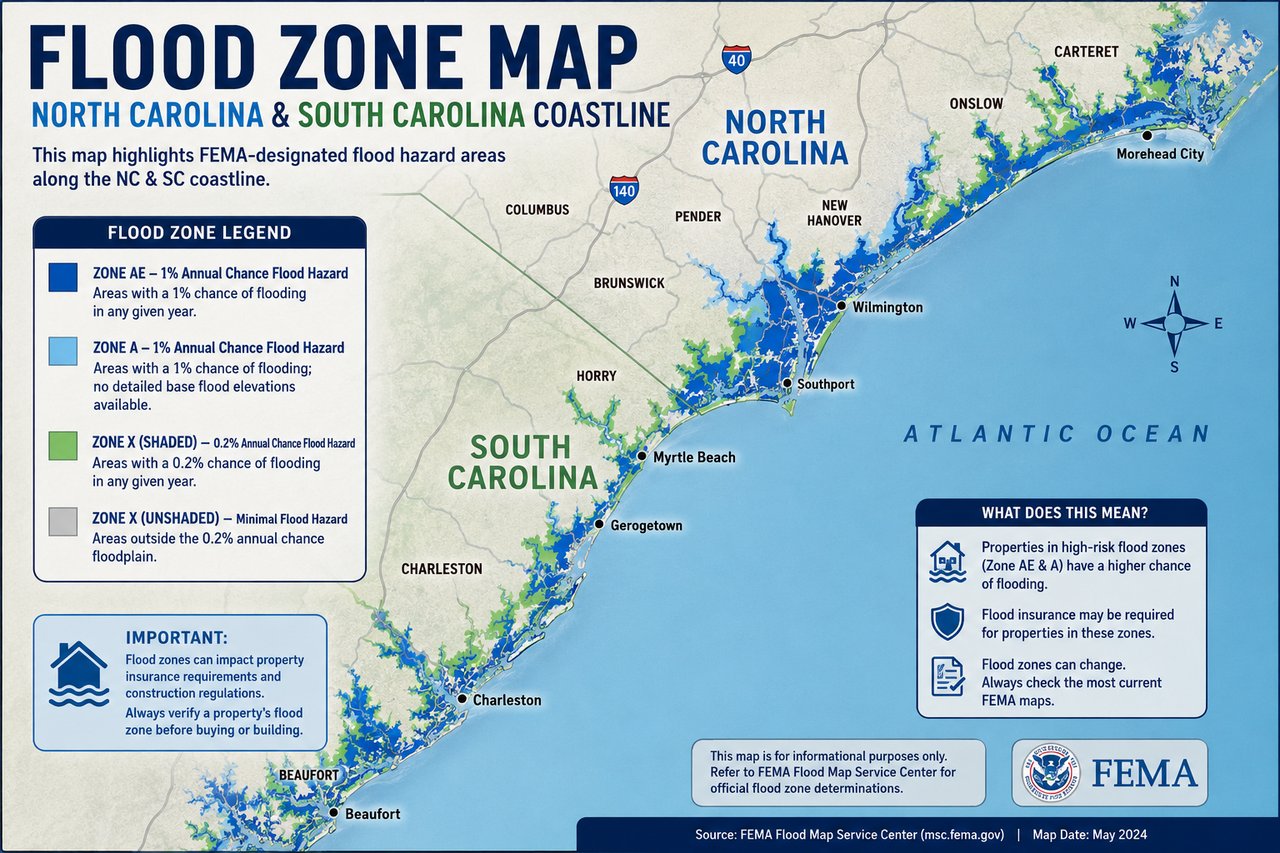
FEMA breaks flood risk into zones, and your zone has a big impact on both your insurance requirements and your premium. Zone X is low to moderate risk, and lenders typically do not require flood insurance there, though it is still smart to carry it. About 20 percent of flood claims nationwide happen outside high risk zones, so low risk does not mean no risk. Zone AE is moderate to high risk and usually requires flood insurance if you have a federally backed mortgage. Zone V or VE covers coastal areas exposed to storm surge, and this is where premiums run the highest.
FEMA also uses a system called Risk Rating 2.0, which prices each property individually instead of relying only on the flood zone map. It looks at your distance to water, your elevation, your home's construction, and what it would cost to rebuild. Two homes on the same street can end up with very different premiums depending on these details.
North Carolina Coastal Numbers
Across North Carolina, the average NFIP flood insurance premium runs around $900 a year. But that statewide number does not tell the real story for buyers along Brunswick County's beaches. Coastal Zone V properties in Brunswick, New Hanover, and Dare counties often see premiums between $2,000 and $5,000 or more per year, while lower risk inland properties might pay $300 to $700.
Many NC beach homes actually need three separate policies to be fully covered: a standard homeowners policy, wind and hail coverage through the NC Joint Underwriting Association, and flood insurance. That is a big change from buying a typical inland home with one policy. Wind and hail rates have also climbed over the last two years, and some standard carriers have pulled back from writing new coastal policies in counties like Brunswick, which has reduced competition and pushed prices up.
One thing worth knowing if you are buying an existing coastal home: NFIP flood policies are assumable. If the seller has a grandfathered policy with a lower rate, you may be able to take over that same policy instead of starting fresh at today's market price. That can mean a real difference in your monthly cost, so always ask for the seller's flood policy declarations page during due diligence.
South Carolina Coastal Numbers
The Grand Strand tells a similar story, with its own set of numbers. Flood insurance in Zone AE typically runs $1,500 to $5,000 or more a year depending on elevation and construction, while Zone X preferred risk policies run closer to $400 to $800.
Homeowners insurance overall tends to run higher in this market than the state average. South Carolina homeowners statewide pay somewhere around $2,700 to $3,100 a year for $300,000 in dwelling coverage, but Myrtle Beach area homeowners often pay quite a bit more than that because of hurricane exposure along the coastline. South Carolina's coast saw 16 severe storms and 12 tropical cyclones between 2020 and 2024, and every one of those events shapes what carriers charge today.
Buyers should also know that FEMA updated its flood maps in 2025, and that update reclassified parts of the Grand Strand, including areas near Socastee, Cherry Grove, and Surfside Beach, into higher risk zones than before. A property that was considered moderate risk a couple of years ago may carry a different classification today, so it is worth checking current maps rather than relying on old information.
Check the Flood Zone for Any Specific Address
Flood risk is not neighborhood-wide. It can change from one lot to the next depending on elevation and distance from water, so the only way to know for sure is to look up the exact property. FEMA's Flood Map Service Center is the official public tool for this, and it is free to use.
Visit msc.fema.gov and enter any address to see its current flood zone, view the official flood map, and download a printable copy for your records or your lender.
For a closer look at how flood zones shift block by block, FEMA's National Flood Hazard Layer Viewer lets you zoom into an interactive map rather than pulling a single address at a time. That is a helpful way to compare a few properties side by side before you settle on a neighborhood.
What Buyers Should Do Before Closing
A few simple steps can save you from surprises after you move in. Ask for an elevation certificate, since this document plays a big role in determining your premium and can sometimes lower your rate. Check the current FEMA flood map for the specific property, not just the general area, since risk can vary block by block. Ask the seller for their existing insurance declarations pages, especially the flood policy, to see if it is assumable. And get quotes early in the process, ideally during your due diligence period, so insurance costs do not catch you off guard right before closing.
Buying on the coast is still one of the best decisions you can make, whether it is a forever home or an investment property. Understanding the real numbers upfront just means you can budget with confidence instead of guessing. If you are thinking about a coastal purchase in North Carolina or South Carolina, I would love to walk you through what a specific property's insurance picture might look like before you make an offer.
Cathy Cagno, Owner/Broker in Charge/REALTOR, Local To Coastal Realty, Inc.
336-516-4136 | localtocoastalrealty.com